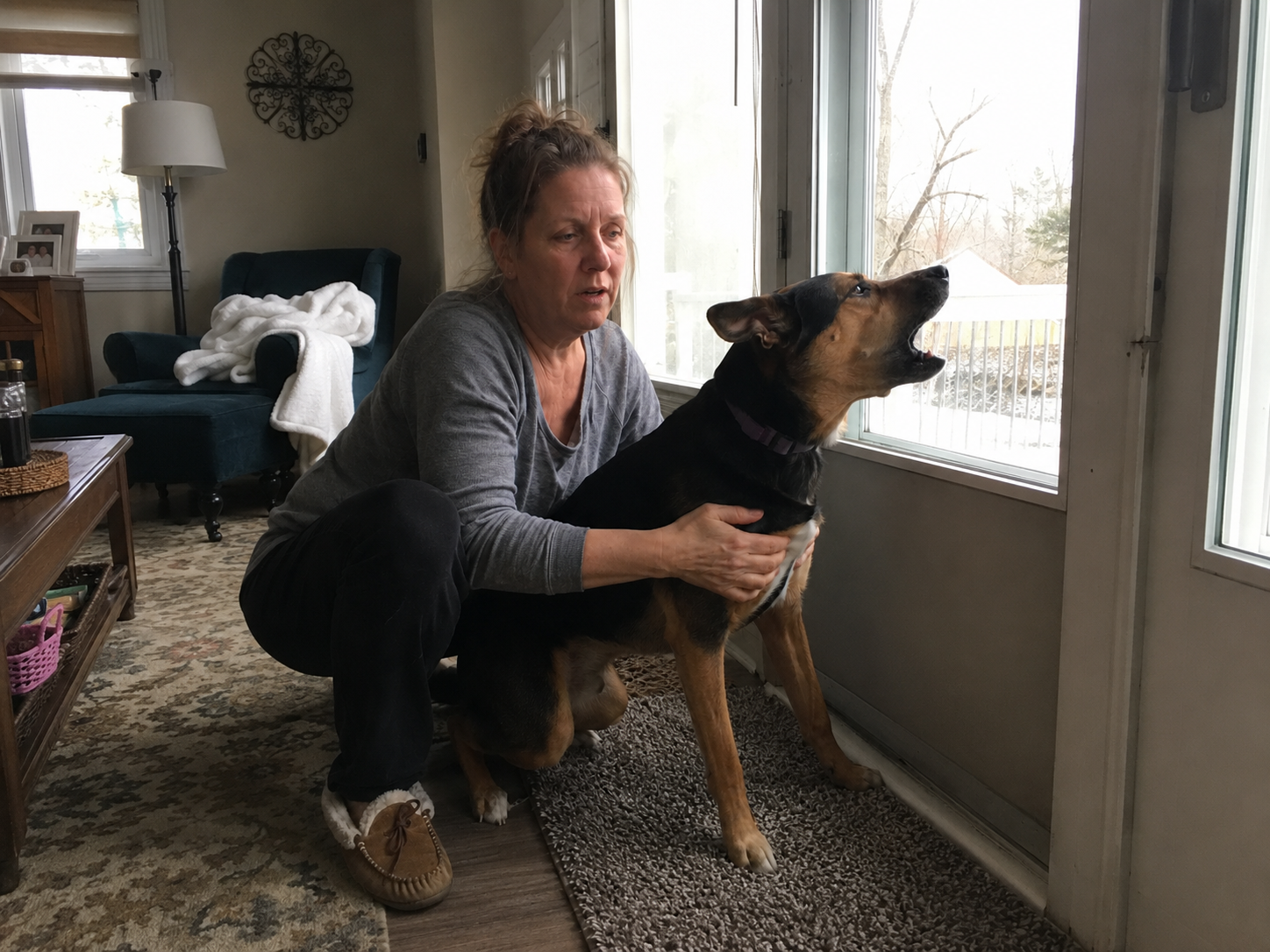
If you’ve ever stood in your own living room shouting “QUIET” at a dog who acts like he can’t even hear you — you’re not doing it wrong. And he’s not ignoring you.
Something else is going on. And once you see it, the whole problem changes.
I know, because I lived on the wrong side of it for four years.
The night I stopped having people over
This is the part of the story I don’t usually tell people.
It started at the door. Someone would knock and he’d go from dead asleep on my feet to launching at that door like it had broken in — barking, scrambling, completely gone. I’d crack it open already apologizing, one hand hooked in his collar, my guest still on the porch waiting for a gap in the noise that never came.
So I stopped opening the door at all. I stopped inviting people. A whole year of “let’s do it another time” because I couldn’t stand one more hallway apology.
And the door was just the loud one. There was the window every evening, the truck he heard a full block early, the squirrel that hijacked every work call until I was running meetings from inside my closet, sitting on a pile of shoes, hoping the client couldn’t hear him through the door.
Different trigger every time. Same exact spiral. Same me, slowly disappearing inside my own house.
I want to be clear: I tried everything
I’m not someone who threw up her hands and bought a gadget. Look at the graveyard on my side table.
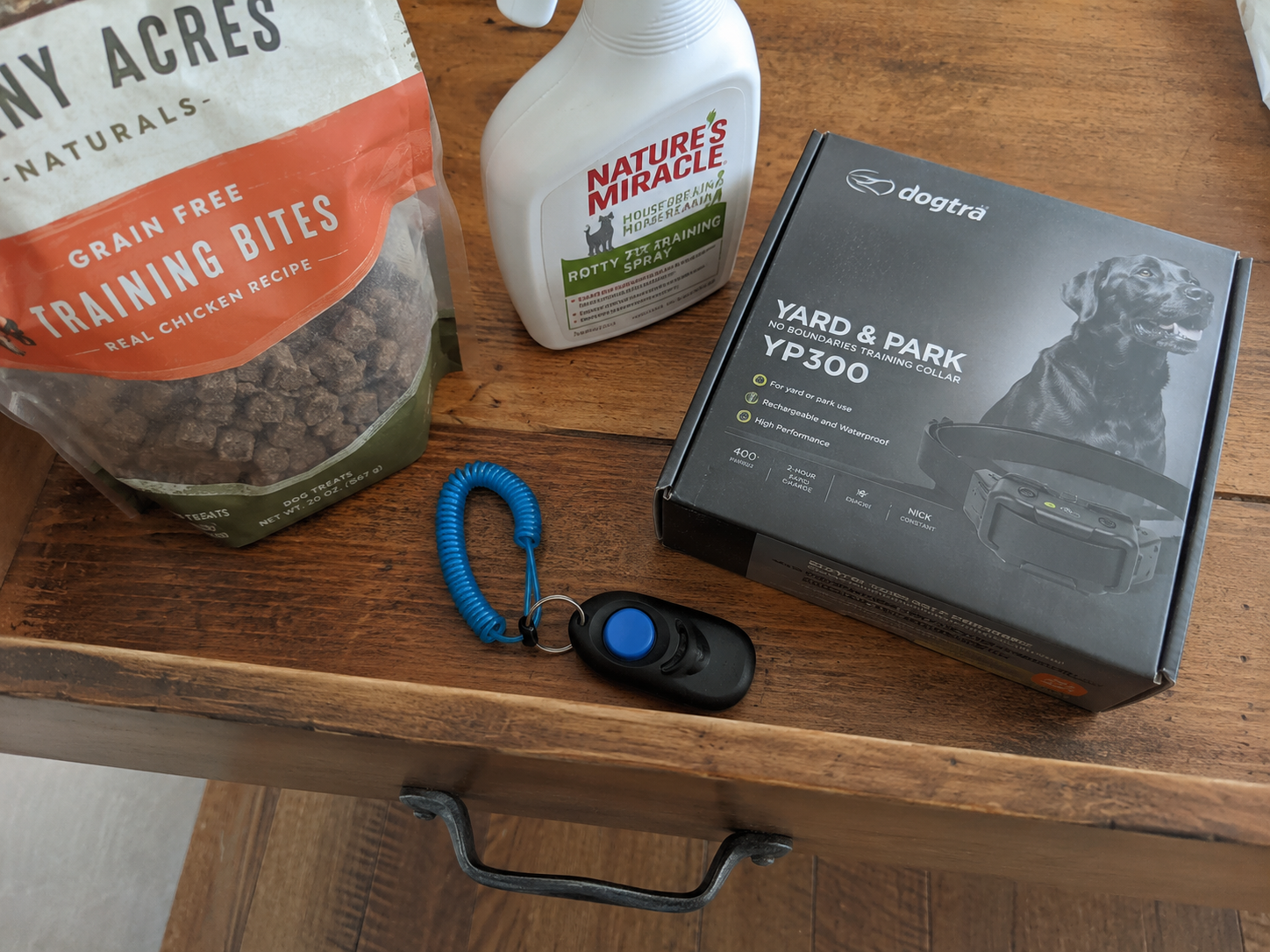
The clicker — I did the whole routine, weeks of it. A bag of training treats so good he’d do backflips for them on a calm day. A “humane deterrent” spray. And a remote training collar I ordered in a low moment, told myself everyone uses them, and then could not bring myself to open. It’s still boxed. I wasn’t going to put something on his neck to hurt the quiet into him.
Here’s the part that broke me: none of it mattered once he was going. On a calm afternoon he was brilliant — clicker, treats, the whole performance. But the second he crossed over into the barking, every tool on that table turned invisible. I wasn’t training him anymore. I was just a person standing in the noise, holding things that didn’t work.
So I’d lose it. And then hate myself for it, because he isn’t a bad dog. He’s just a dog doing a dog thing — and I was the one falling apart.
Then I read the one thing no trainer ever told me
One night I went looking for answers, and I read something that genuinely broke my brain a little.
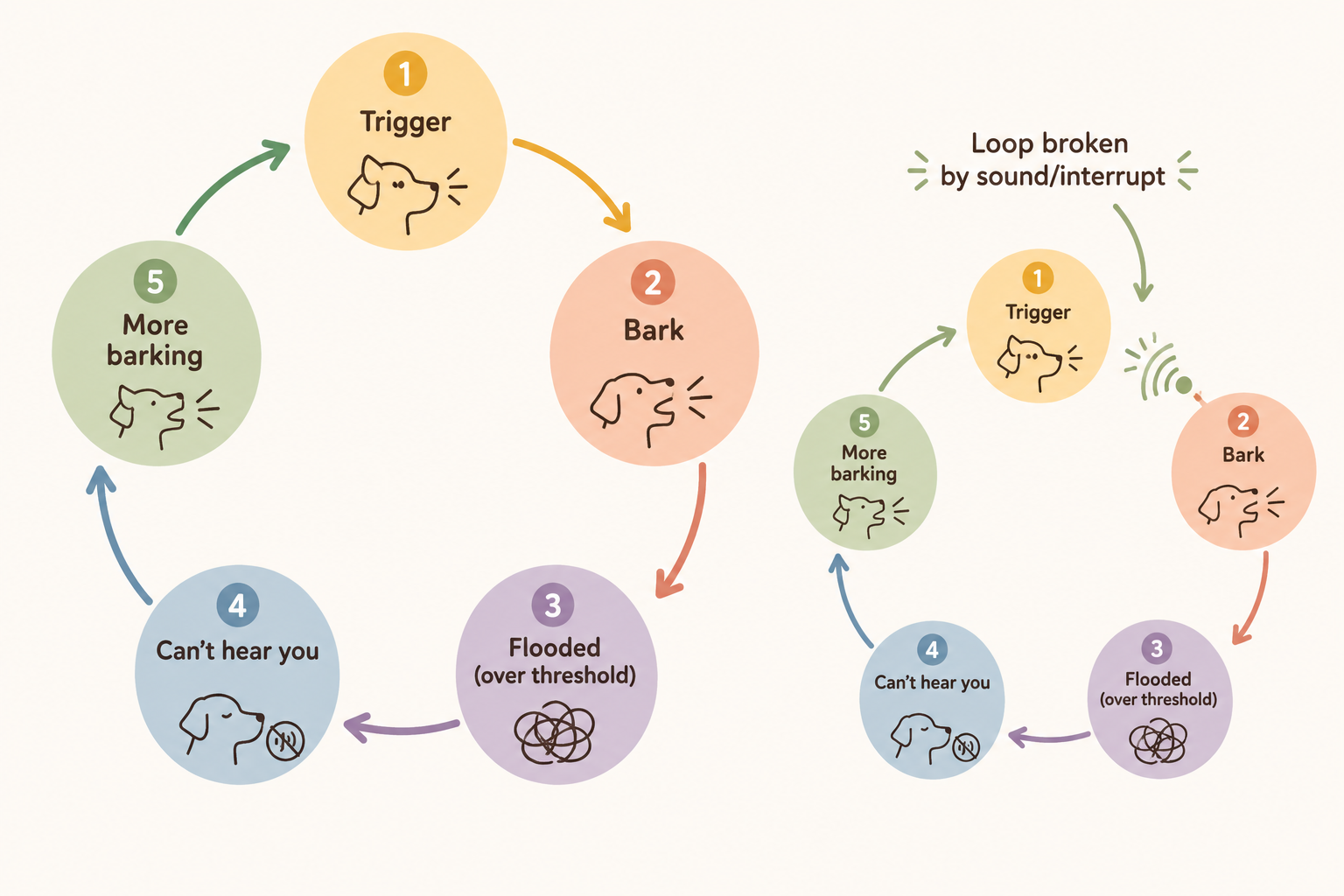
Once a dog is spun up like that, your voice stops being a command. It just becomes more of the noise he’s already reacting to.
He’s not ignoring you. He physically can’t land on you yet.
Trainers have a name for this state — the dog is “over threshold.” He’s flooded. His attention is locked onto the trigger, and everything else, including you, is just static. You can have the best “quiet” command in the world and it will not work, because there’s no one home to receive it.
That’s the part that changed everything for me.
I’d spent four years trying to make him obey in a moment he couldn’t even hear me in. The problem was never obedience.
I had to interrupt the loop first. Then redirect him.
Why “interrupt before you instruct” actually works
Here’s the thing the good trainers do that the videos never spelled out for me.
When a dog is fixated and barking, they don’t repeat a command into the noise. They use a pattern interrupt — a quick, neutral signal that snaps the dog’s attention off the trigger for half a second. A sound. A movement. Something that makes him go “…what was that?”
That tiny pause is the whole game. Because in that pause, his attention resets — and for the first time, there’s someone home to redirect.
So the real sequence isn’t bark → command → frustration. It’s:
Interrupt the loop → his attention resets → you calmly redirect.
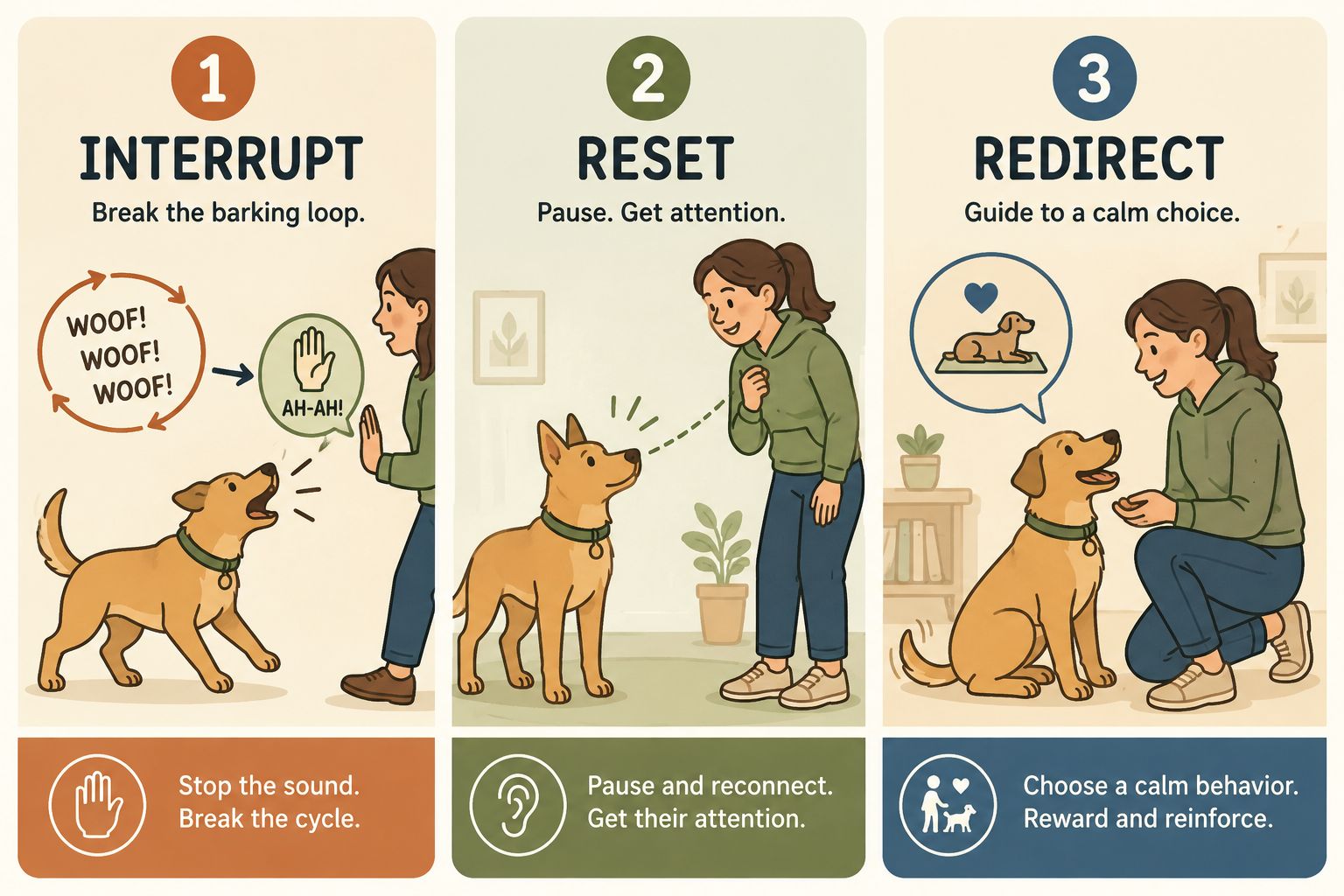
This is how positive-reinforcement trainers handle reactive dogs without dominance, without fear, without pain. You’re not punishing the bark. You’re just breaking the spiral long enough to reach him.
Once I understood that, I stopped looking for a better command. I started looking for a better interrupt.
The Ultrasonic Attention Reset
The interrupt I landed on is a method I now think of as the Ultrasonic Attention Reset.
It’s simple: a brief, high-pitched sound cue — one dogs notice clearly, but that doesn’t hurt them. No shock. No vibration into his neck. No yelling.
It’s not a punishment and it’s not a “bark stopper.” It’s a pattern interrupt he can actually hear through the noise, because it cuts across the exact frequencies he’s tuned into when he’s fixated.
Just enough to make him pause and look at me. That half-second of “…what was that?”
And that half-second is the door back in.
The tool I use to deliver it
The device itself is the boring part, honestly — it’s just the simplest way to deliver that reset on demand.
It’s a small handheld button. Sonavia. Press it, and it gives off that short ultrasonic cue.
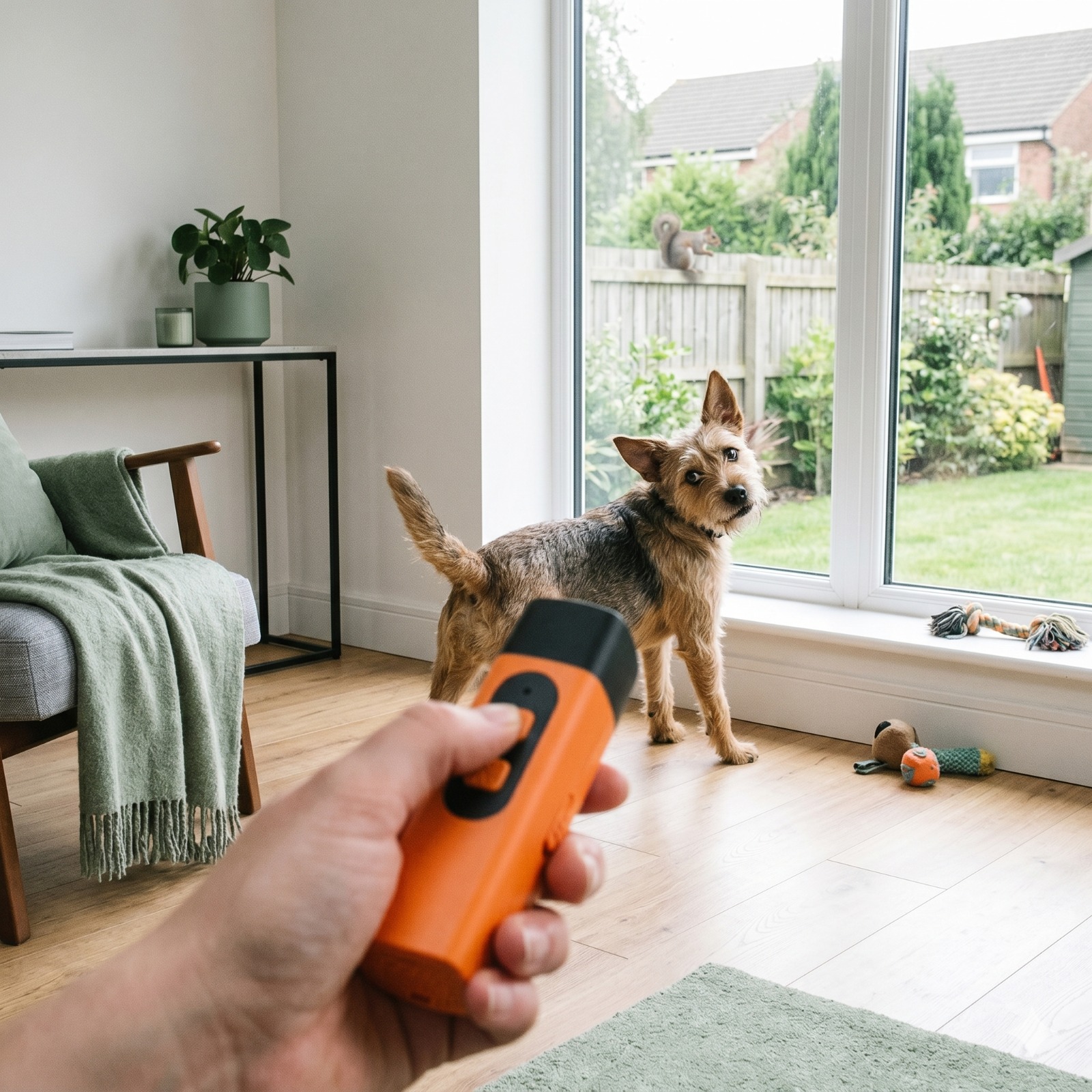
The whole routine is three words:
Press · Pause · Redirect.
- — He’s barking at the window → I press the button.
- — He stops and looks → that’s the pause, his attention resetting.
- — I calmly redirect him — “over here,” a hand target, a spot to settle.
No collar around his neck. No spray in his face. No shouting match I always lost. Just a quiet reset and a calm redirect.
Every part of it ties back to the same idea: I’m not trying to overpower the bark anymore. I’m interrupting the loop so I can finally reach him.
What to honestly expect
I’ll be straight with you, because the false-promise stuff is exactly what burned me before.
This is a tool for interrupting and redirecting. It is not a magic off-switch, and anyone who tells you a button “cures barking instantly” is lying to you.
Here’s what it actually looks like:
- The first few times, you press, he pauses, you redirect. The pause might be short. That’s fine — the pause is all you need.
- Over the first week or two, if you’re consistent with the redirect every time, a lot of dogs start to settle faster, because the spiral gets interrupted before it builds full steam.
- It works best paired with the redirect, not on its own. The button buys you the moment. You fill that moment with something calm.
Results vary dog to dog. A confident, food-motivated dog redirects quickly; a more wound-up one takes more reps. That’s normal.
What other owners have said
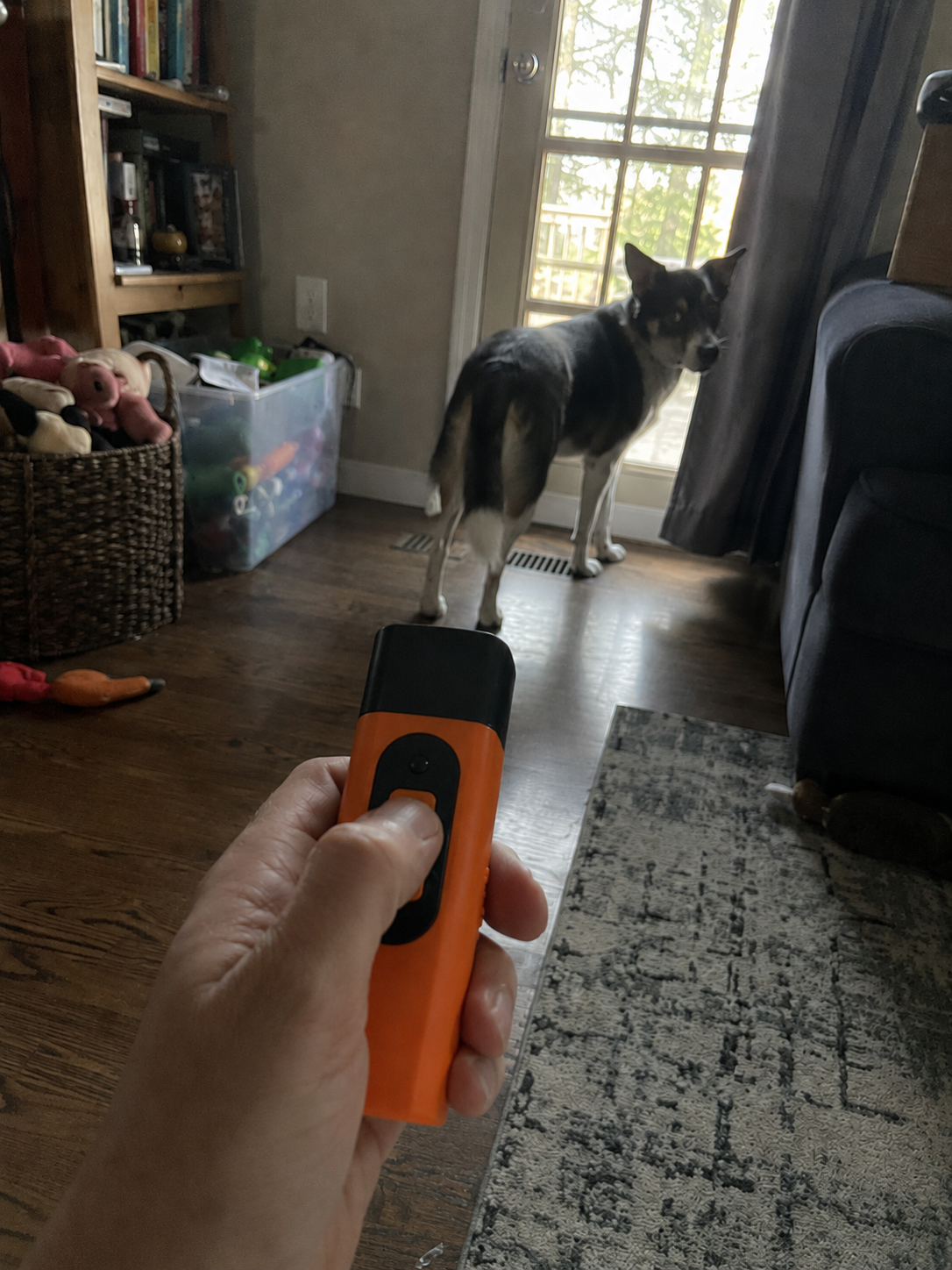
“I didn’t think a sound button would do anything honestly. But it’s not about stopping the bark — it’s that he actually looks at me now instead of just spiraling. Took about a week before I trusted it would work. Still notices everything, just comes back to me faster.”
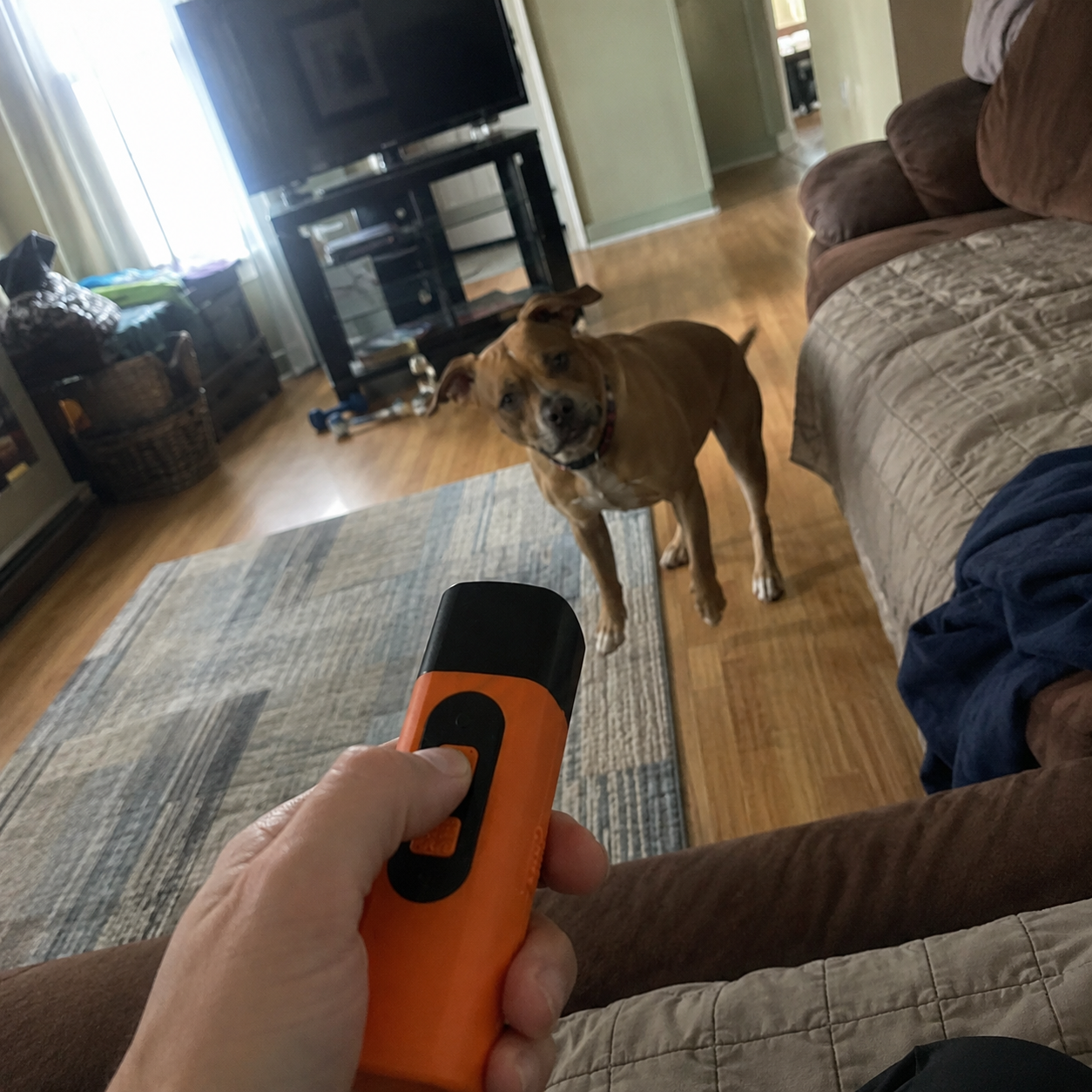
“We live in a building so every hallway noise used to set him off. What sold me wasn’t that he stopped barking — he didn’t, not at first — it’s that I finally had something to do in the moment besides grab him and panic. That part alone changed how I felt about having people over.”
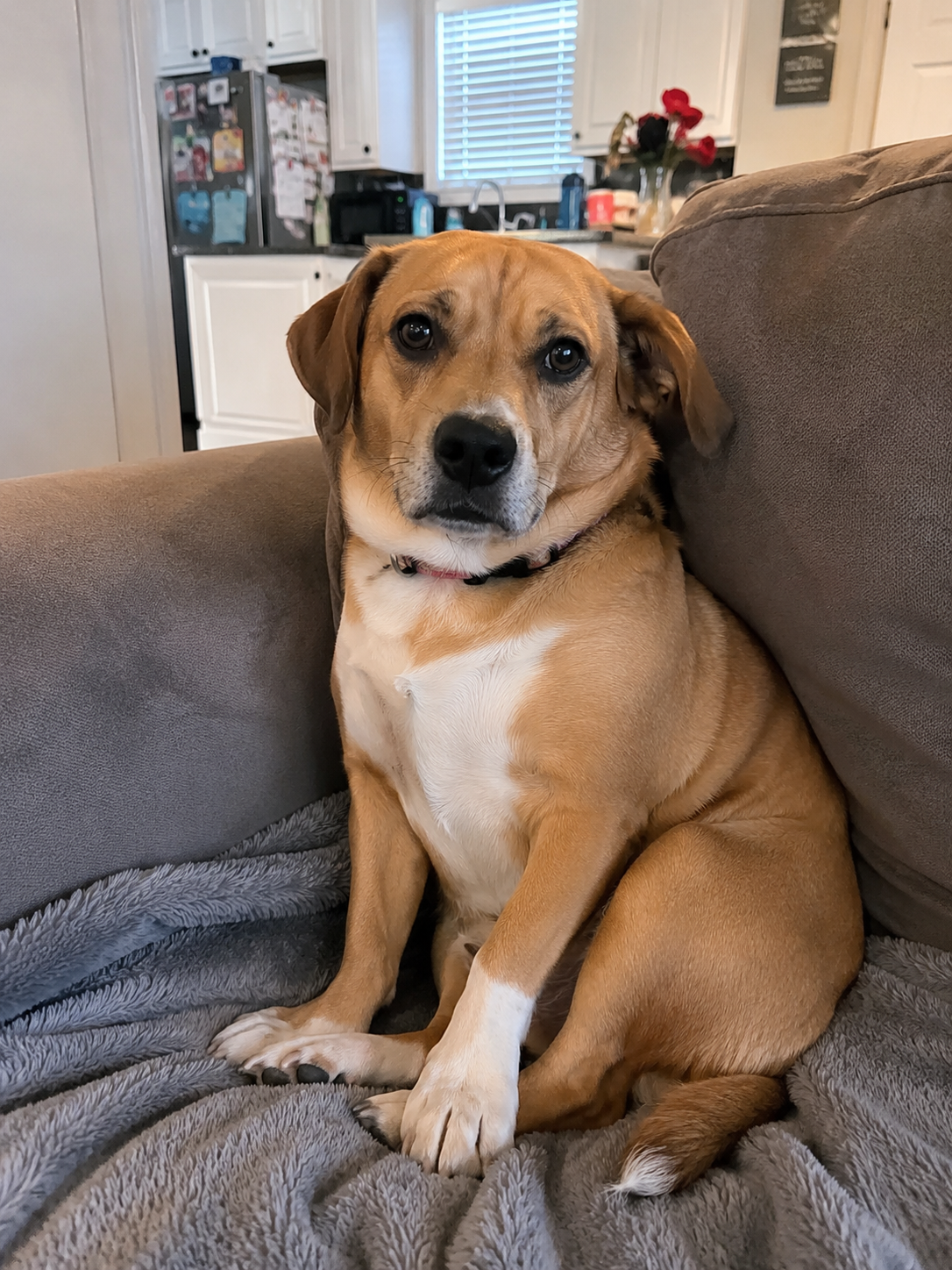
“I looked into shock collars for almost a year and could never do it. This felt like a real alternative, not a watered-down version of one. My dog still jumps at the doorbell, but he checks in with me after instead of going for two straight minutes.”
“I’ve bought basically every gadget on this list at some point — sprays, clickers, the whole drawer. This is the first one that didn’t promise to fix him. It’s a tool you still have to use right, which honestly made me trust it more, not less.”
Individual results vary. These are individual experiences, not a guarantee of typical results.
Your questions, answered straight
- Does it hurt him? Is it safe?
- No shock, no pain. It’s a high-pitched sound — the canine equivalent of someone clearly saying your name across a noisy room. It gets his attention; it doesn’t punish him. That’s the whole point of choosing this over a shock collar.
- Will it work on my breed?
- The mechanism is about attention, not breed or size — it’s worked for tiny barkers and big reactive dogs alike. The thing that matters most isn’t the breed, it’s whether you follow the press with a calm redirect.
- What about my older dog — his hearing isn’t what it was?
- Honest answer: it relies on him hearing the cue. A dog with significant high-frequency hearing loss may not respond, because there’s nothing for the interrupt to land on. If hearing’s a real concern, that’s worth knowing before you buy.
- Isn’t this just a dog whistle?
- Same family, different job. A whistle is usually a recall cue you train over time. This is a pattern interrupt — used in the heat of the moment to break the loop so you can redirect. It’s about the timing and the routine around it, not just the sound.
- What if he just ignores it?
- Some dogs tune out a repeated sound if you lean on the button alone — which is exactly why this isn’t a “press and walk away” gadget. The interrupt only keeps its power when it’s paired with a redirect every time. Press, pause, redirect. The reset opens the door; the redirect is what he learns.
- How is this different from a shock collar?
- A shock collar adds pain to suppress the bark. This adds a neutral sound to interrupt it, so you can guide him to something calmer. One works through fear. This one works through attention. That difference is the entire reason I use it.
The calm version of your home is still in there
Here’s what I got back.
I have people over again. I sit down at 6pm and actually stay sitting. The truck still comes and he still notices — but I can call him off it in seconds instead of shouting. And at the end of the day he puts his head in my lap, and I remember we were always capable of this.
He’s still a dog. He still notices the world. I just finally have a humane way to break the spiral and get his attention back — no yelling, no shock, no standing in my hallway apologizing.
If any of this sounded like your living room, your couch, your front door — it’s worth understanding how the reset works before the next knock, the next truck, the next quiet evening that gets hijacked.